


THE KHORDAD 1385 (MAY 2006) MOVEMENT
— A TURNING POINT OF NATIONAL AWAKENING
Statement of the South Azerbaijan Liberation Party (GAQP)
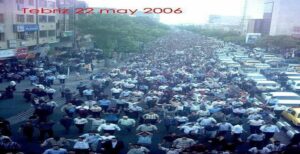
In May 2006, the popular uprising that began in Tabriz and spread across many cities of South Azerbaijan entered history as the “Khordad Movement.” These events were not merely a spontaneous reaction to an insulting caricature; they were the collective protest of the Azerbaijani Turkic Nation against decades of national discrimination, denial of identity, political repression, and systematic assimilation policies.
The national outcry that rose from Tabriz rapidly spread to Urmia, Ardabil, Zanjan, Sulduz, Khoy, Maragheh, and other Turkic cities. The voices echoing through the streets revealed one truth to the world:
The Turks of South Azerbaijan are determined to preserve their national identity, language, and historical existence.
The slogan “Haray-Haray, I am a Turk!” became one of the defining symbols of the Khordad Movement and continued to live on in the collective memory of the South Azerbaijani National Movement as a historic declaration of fearless national identity.
The defining characteristic of the Khordad Movement was its national character. This uprising was:
• a response to the denial of the rights of the Turkish language within the Persian-centric Shuubi system of Iran;
• a reaction against the systematic repression of the national dignity of non-Persian peoples, especially Turks;
• a rise of the will for freedom against centralized and racist state policies;
• and a protest against the denial of the historical, political, economic, and social existence of South Azerbaijan.
The harsh repression of the Persian-centric Iranian state system — including mass arrests, security crackdowns, and armed interventions — failed to break the will of the Azerbaijani Turkic Nation. On the contrary, the Khordad Movement strengthened national consciousness in South Azerbaijan and marked the beginning of a new phase in the Azerbaijani National Movement.
After this uprising:
• national student movements expanded in Azerbaijan, Tehran, and the Qashqai regions;
• national diaspora organizations became more active both inside Iran and internationally;
• national media and online networks gained a stronger political and cultural presence;
• the cultural struggle for Turkic identity seriously challenged the state-sponsored “Azeri” narrative;
• and a new wave of forced exile against national activists emerged.
THE HISTORICAL VERDICT OF THE KHORDAD MOVEMENT
The Khordad Movement proved that:
A nation’s language may be banned.
Its activists may be imprisoned.
Its youth may be forced into exile.
But a nation’s collective memory can never be erased.
No oppressive regime possesses the power to erase the national memory of the Azerbaijani Turkic Nation — a nation that for centuries contributed statehood, justice, freedom, equality, and the right of native languages to survive in this region.
Today, the Khordad Movement is not merely a memory of the past; it remains a living symbol of national resistance, political awakening, and the will for freedom in the contemporary history of the South Azerbaijani National Movement.
Long live South Azerbaijan!
Long live the freedom will of the Azerbaijani Turkic Nation!
The memory of our national martyrs shall never be forgotten!
South Azerbaijan Liberation Party (GAQP)
2026-05-20